Gary Larson Far Side Cartoons if You Love Larson Read His Latest Note
Gary Larson Hesitantly Logs on to an Internet Whose Culture He Helped Create
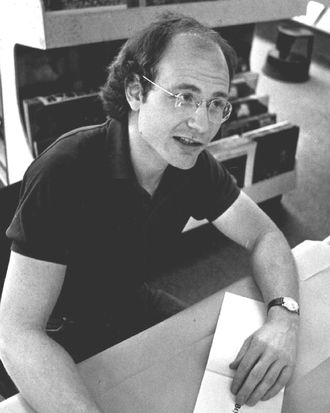
Photograph: Denver Postal service/Getty Images
This morning, the website of Gary Larson'due south famed comic, The Far Side, started displaying strips from the serial. This may seem similar a baseline expectation for a love comic strip, but for Larson, it's a big deal. With respect to Calvin and Hobbes and the i Garfield where Jon Arbuckle maybe drinks dog semen, The Far Side is, in my (and many others') opinions, the greatest comic strip of all time. Withal it has never been made available online in any official capacity. Information technology's even more surprising when you consider that The Far Side has been helping to shape the culture of the internet since the very start.
First today, thefarside.com will offering an assorted collection of rotating daily strips, equally well as strips grouped past themes. Before it was updated earlier this year with a "coming soon" graphic, The Far Side'southward website had non changed in more than 18 years. It looked the same a few months ago every bit it did in 2001. In the absenteeism of an official archive, fans took to posting and hosting the comics themselves. Larson rarely speaks to the press (prior to an email interview in today'southward New York Times, I believe his last 1 was in 2003), but in 2007, he published an open letter online. "On the one mitt, I confess to finding it quite flattering that some of my fans take created web sites displaying and/or distributing my work on the Cyberspace," he wrote. "And, on the other, I'yard struggling to find the words that assuredly simply sensitively persuade these Far Side enthusiasts to 'end and desist' before they accept to read these words from some lawyer."
He wrote that he was less interested in the financial hit he might take if the comics were made bachelor for gratuitous, and more than in the emotional toll:
These cartoons are my "children," of sorts, and like a parent, I'm concerned about where they go at night without telling me. And, seeing them at someone's web site is like getting the call at 2:00 a.m. that goes, "Uh, Dad, you're not going to like this much, simply guess where I am."
Larson'south letter of the alphabet seemed like it might go a archetype case of the Streisand effect, which results in drawing more attention to something past asking people to pay less attention to it. Yet against all odds — especially given how blatant copyright infringement is on the cyberspace — people mostly adhered to the asking. Information technology became difficult to find a fundamental repository of Far Side comics, though they still showed upwards hither or there.
That absenteeism over the past two decades is sort of a shame, given the specially net-y, meme-like brand of sense of humour apparent in many of Larson'southward single-panel comic strips, which crave absolutely no context other than what's in front of you. (Sure, other strips similar Family Circus are in a unmarried-panel format, but they practice a much less eccentric brand of humor.)
Despite Larson'due south 2007 edict, at least ane of his comic strips has grown famous online: 1982's "Cow Tools," which is among the very first grouping of strips republished online today. "Moo-cow Tools" (I don't think I tin postal service it here, simply hither'due south a link) shows a moo-cow standing in forepart of some misshapen "tools." The caption reads, "Cow tools." Yous can meet them below in this Tumblr meme.
In 1982, the strip provoked nationwide controversy that mirrored the controversy around 2015'southward viral sensation The Wearing apparel. Readers puzzled over the strip, trying to decipher what the tools were supposed to be. Readers called editors to inquire. Eventually, Larson had to issue a statement on the matter. "The cartoon was intended to be an exercise in silliness," he wrote (based on considerable reporting experience, this is also what people who make viral memes without much idea oft say). He added, "I regret that my fondness for cows, combined with an overactive imagination, may have carried me beyond what is comprehensible to the boilerplate 'Far Side' reader."
The reply is, but similar nonsensical cyberspace jokes, that the tools were non supposed to be anything at all. Reflecting on the incident years later, Larson wrote, "The first mistake I made was in thinking this was funny. The second was making one of the tools resemble a rough handsaw — which made already confused people decide that their merely promise in understanding the cartoon meant deciphering what the other tools were too. Of form, they didn't have a chance in hell."
He summarized the whole "Moo-cow Tools" debacle like so: "I drew a really weird, obtuse cartoon that no one understood and wasn't funny and therefore I went on to even greater success and recognition." A classic pre-online online success story. Gary Larson's work was made for the internet, fifty-fifty if he is reluctant to admit it.
This morning, he effectively threw in the towel, acknowledging that since his first open letter, technological advancements have fabricated information technology possible for him to present his comics in adequately high resolution. In another open letter of the alphabet, he best-selling, "Trying to exert some command over my cartoons has always been an uphill slog, and I've sometimes wondered if my absence from the web may take inadvertently fueled someone'southward belief my cartoons were up for grabs. They're not."
Even if it'due south not the whole collection, and even if the participation is washed with much reluctance, getting something is certainly style better than nil to long-time fans. To Larson, the www is no longer a Cow Tool.
Source: https://nymag.com/intelligencer/2019/12/gary-larson-finally-puts-the-far-side-online.html
0 Response to "Gary Larson Far Side Cartoons if You Love Larson Read His Latest Note"
Post a Comment